Friday, 9 May 2014

Toad Story


Guests on our natterjack toad guided walk
We are lucky to be part of the Duddon Estuary which is home to approximately 25% of the entire population of natterjack toads in the UK.  Here at Sandscale Haws we have about 1000 breeding adults and are one of the best places to see them up close.  As they are such a vulnerable species, it is illegal to not only handle them, but to also disturb them in any part of their life cycle.  For this reason Neil and myself hold a license, this allows us to monitor their population and give educational demonstrations out on site.
By monitoring the size of the toad population over many years, we can ensure that we have the balance of our reserve management just right.  Our tall, rank vegetation is grazed by our livestock, this keeps the grasses and rushes low in order for other flora to thrive.  Trampling of the ground by cattle also exposes bare sandy patches which allow pioneer plant species to establish, as well as providing areas for the natterjacks to burrow into for shelter.  This rich floral community provides habitat for thousands of insects of which our toads will amble after for it's dinner.  Natterjacks being short-limbed need this flora to be kept short to journey over, this is done by  the grazing.  In summary, by keeping the numbers of grazing animals at the right levels, in the right place, we can ensure a happy, healthy population of natterjack toads.
Fresh spawn. Photograph by Rod Mills
 Monitoring is done by walking around the margins of all our pools at least once a week during breeding season (mid-April and mid-June) and recording the number of spawn strings seen.  Fresh-laid spawn can be easily recognised as a double row of spawn, after a few days it becomes transformed in to a single row (see previous blog for photos).

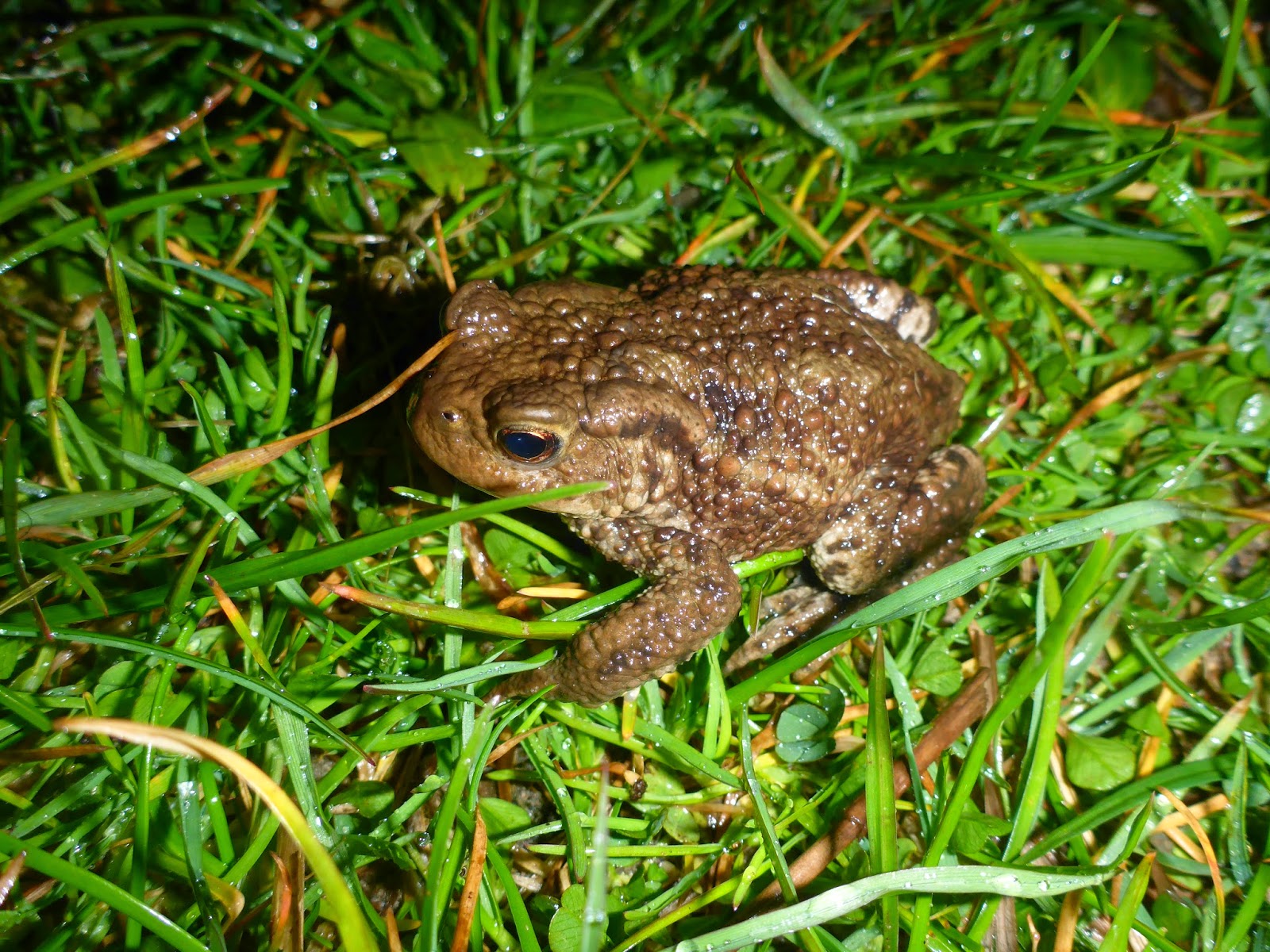
Natterjack toad on left, Common Toad on right
The skin of toads appears warty with large glands behind their eyes.  The largest distinguishing feature to separate the natterjack from the common toad is the yellow line down the middle of it's back.  Every line is different and can be used to identify an individual, very occasionally, though, you will come across a natterjack with no line.  In this instance the colour of the iris gives the game away, with the common toad having a copper or amber colour and the natterjack having golden irises.
Natterjacks are generally smaller reaching a length up to 7cm, with the common toad getting up to 8cm.  Between the sexes, the female is usually the largest, requiring more body weight for egg production.  The male can also be recognised by two darker inner edges of the first two toes on it's front legs.  These are called nuptial pads and help him provide a firm grip on his female whilst in amplexus (mating).  Along with darker toes, the males "wear the trousers" in the toad world and when on his back can be seen to have a line of darker pigment on his back legs that the female toad doesn't have.
The male toad's nuptial pads
The males "wearing the trousers"
The male toads call from the edges of breeding pools to attract the females over. By inflating their vocal sacks their chorus can be heard up to 1km away, making them the loudest amphibian in Europe

The male toad uses his nuptial pads to keep a firm grip on his female whilst in amplexus
2014 monitoring so far...

So this is what our more mature spawn looks like at the moment...no wait they are tadpoles!  It is not possible to distinguish between the species of tadpoles at this stage, however the common toad tadpoles are marginally bigger as they were laid earlier in the season.  Also side by side the natterjack tadpoles have a slightly more pointed nose and appear less active than the common toad tadpoles.  The common toad tadpoles like to move about as a shoal in the deeper areas of a pool, whereas the natterjacks are loners and prefer the warmer more shallow areas.  As they grow, natterjack tadpoles will develop a white chin, and as they grow legs they get their yellow stripe, starting in the centre of their backs.  Hopefully in the weeks to come I can show you more of their development...


Summary of spawning history

Year
Number of pools used
Spawn count total
2008
24
473
2009
8
194
2010
19
494
2011
15
527
2012
10
328
2013
23
305
2014
14
385 so far

Thursday, 17 April 2014

Natterjack Toad Guided Walks 18th and 25th April 2014

It is illegal to disturb natterjack toads in any stage of their life-cycle without a license, a guided walk by our licensed rangers ensures the best experience of these amazing creatures.

18th and 25th April 2014 7.30pm from our car park (Hawthwaite Lane, Roanhead, LA14 4QJ)
The walk is about 1.5miles over uneven terrain and beach, passing water courses.  Please bring a torch and warm clothing.
 
2014 The story so far...
The evening of the 30th March was kick off for the new natterjack toad breeding season, as the males started calling beside the pools.
It wasn't until the 7th April that we had actually recorded any spawn strings.  This is a freshly laid spawn string still formed as a double helix.  Looking into the water from above they look like black bootlaces.
After a few warm days the spawn have separated in their jelly strands.
A week on, since conditions have been suitable, they have ingested their jelly and have started to look like little black commas.

Stay tuned to see our little babies grow up...

Thursday, 20 March 2014

Love My Beach!


Thousands of people come each year to visit our stunning beach but we need to make sure we keep it this way.  Threats from pollution in the sea, litter and dog poo can all hinder your enjoyment and damage habitats and kill wildlife.
A European Directive coming into effect from 2015 will mean that higher standards of water quality will need to be met in order for our water to be safe for swimming and paddling.
By working together with businesses, farmers, visitors, Town and Parish Councils and volunteers we want to exceed these required standards by 2015.

We kicked off our membership of LoveMyBeach with a good old beach clean, which attracted 12 people who collected 320kg of litter.

If you would like to get involved our next Beach Clean is 12th April 10.30a.m from our car park, Roanhead, Hawthwaite Lane, Near Barrow in Furness LA14 4QJ

For more information call 01229 462855 or visit the LoveMyBeach website at http://lovemybeach.org/

Tuesday, 18 March 2014

By request...


So February started out with yet another high tide taking out our salt marsh fence

We also had further erosion to our rock armour protecting the fishing huts at the southern area of the reserve

I was allowed out on day release to visit Nether Wasdale in the Western Valleys.  Here I was planting native trees for a more natural transition from wooden valley floor to open hillside

I had another excuse to go walkabout when I took some of our volunteers up to Wathenlath Tarn in Borrowdale to learn how to hedgelay.  This is brilliant experience, sharing skills and knowledge from other Rangers in the Lakes.

Back on site and we have a few slacks like this that have become overgrown with wood small-reed which the cattle don't like to eat.  This lessens plant diversity in this area.
Therefore we invited the boys in from the Western Valleys and the other Rangers from our patch with their brushcutters and got them to work, acting like mechanical cows.


Volunteers from Sizergh, including Tom Price the Gardner came and raked the reed off, as well as chopping down some tough hawthorn, and removed it from site.

Lets hope after all that hard work the cows will now get in there and stay on top of their munching.  With Spring just around the corner, it will be great to see what pops up in its place.

Talking of popping up, we had yet more Snow bunting.  The first flock we recorded got up to 21 in number, but since then only 9 have stayed on.

So the news you've all been dying to hear is...we've finished the first stage of our boardwalk project.  To open it (using loppers and hazard tape) we invited Ann Thurlow, Mayor of Dalton-in-Furness, who we're also honoured to have as one of our volunteers!

Whilst I skip off into the sun, Ranger Dog Bob looks on in sheer embarrassment that I'm his!

Tuesday, 28 January 2014

The Grand Boardwalk Project has Started!

But first lets play eye spy to try and find these little busy bodies of the coast.  Four Turnstone

So this was how the start of our boardwalk looked before.  The vegetation had grown over and the slippy wooden boards had warped
Using a mattock we were able to prise the old board away from the rotten runner below, leaving a level bed of sand underneath.
We lay new recycled plastic runners down in place of the old wooden ones.  This time we used 6 in order to build a stable platform less likely to bend as demonstrated by our old boards.
First a pilot hole was drilled through the board, then the hole was drilled with a countersink bit in order for the screws to sit tightly below the surface to prevent any trip hazards.  Due to the nature of using plastic, we had to carefully allow 1cm spacing between each board in order for the plastic to expand and contract in the changing weather conditions
The runners were drilled through and attached using a coach bolt.  This just prevents the boards moving away from each other
The tools of our trade, includes three drills as it saves time changing bits.
The story so far...come back and see more from the remainder of our project soon

Monday, 13 January 2014

After the storm came the floods...

Friday 3rd January saw a 9.97meter high tide with South Westerly winds of 48mph.  This meant that the Southern parts of our reserve that is often protected by Walney Island experienced mass flooding.  In this area we have 19 privately owned fishing huts which were all engulfed with waves, many reaching up to the windows even though they are all on stilts.  Here is the footage...

Tuesday, 17 December 2013

The Great Storm of 2013


Thursday 5th December was no ordinary day here at Sandscale.  We had high tides of 9.81meters and the gusts of 63mph winds were pushing the tide even higher.  Although we had to cancel the volunteer work party, Neil and Myself were lucky enough to capture the events on camera...
This is the view from the boardwalk, usually the tide will be a good meter away from our frontal dunes on a really high tide.  Here our frontal dunes are just being engulfed by the storm surge.
This view of our blowout is only impressive when you learn that the bush at ground level used to be at the top of the dune.  Later this shrub was found just below our boardwalk, half a mile away
 This footage was captured whilst being stood inside the blow out, an hour before high tide.  Needless to say we couldn't hang around for long.

So what sort of damage was done?  Here are our before and after shots...
 Using the tree in the background as a marker, you can see the front ridge has all but disappeared

 The fence from the blowout that was catching sand and starting to build up as a ridge has completely gone, along with our fence.

Although dramatic, this is really good news for us.  Sandscale is a dynamic system with constantly shifting sands.  More bare sands create a good habitat for early pioneer plants.  It's also great news for our Natterjack Toads who bury into the sand dunes and hunt along the shore where vegetation is sparse.