Saturday, 2 May 2015

Natterjack Season!


Natterjacks in amplexus


 Here at Sandscale Haws we are lucky enough to have the nationally rare Natterjack toads call our site home. We also have one of the largest and most stable populations in the UK with an estimated 500 pairs breeding here each year.

Natterjack toads can be found at only 60 sites across the UK with the Cumbrian coast supporting at least 50% of the UK population and the Duddon Estuary, which we are situated on, being home to approximately 25% of those.

Natterjack numbers have declined drastically in the last century mainly due to habitat loss and as such they are protected by both British and European law making it illegal to kill, injure, disturb and even touch them.

Here at Sandscale the Ranger team have licences to monitor Natterjack numbers every year to see how they do from year to year. 2014 was a great year as we counted over 400 spawn strings and in excess of 40,000 toadlets!


Natterjack toadlets

Unfortunately it’s been a bit of a slow start to 2015 due to the cool spring we’re experiencing and the low water levels across the site. Our first record of the year was on the 7th April in one of our most westerly dune slacks where we found two spawn strings in between common toad spawn strings. Unfortunately due to the lack of rain we’ve had this winter the pool had dried up when we visited it again just 6 days later.
Our first Natterjack sighting of the year though was 8 days later on the 15th when we found a couple of pairs spawning down in the shallow pools on Roanhead beach and again on subsequent days after that. As of the end of April we are now up to 67 spawn strings laid across the site.


Natterjacks in amplexus laying spawn (black strings)

We’ve held a couple of public Natterjack walks in the evenings during April and visited both dune slacks out on the main reserve and our breeding pools near the car park to see what we could find and hear across the site. So far we haven’t heard any chorus’ out on the main reserve but we have had Natterjacks calling at the two breeding pools near the car park and along Roanhead beach, which has been one of the main sites used so far this year. 


Male Natterjack calling

We’re hoping that both temperatures and rainfall pick up a bit soon so that we see more Natterjack numbers and spawn strings but it may be that many Natterjacks give this year a miss if the pools do not refill over the next couple of months. However we still hope to have tens of thousands of Toadlets by mid-June in the sites that have been used.

We’ll keep you posted about how things are going in a couple of months so be sure to check back then.

Male Natterjack

Finally this week saw the extremely worrying news from Amphibian and Reptile Conservation that a new species of Chytrid fungus has been found in the UK. These waterborne fungi have been implicated in dramatic declines and even extinctions in amphibian populations around the world. Whilst this new fungus has not yet been recorded in the wild in the UK it is known that another Chytrid fungus is here and is present at many sites. We urge anyone that visits wetland sites to disinfect their footwear and equipment between sites to stop both the spread of diseases and invasive species. Please follow the advice provided by the GB non-native species secretariat at http://www.nonnativespecies.org/checkcleandry/documents/check-clean-dry-poster.pdf

Tuesday, 21 April 2015

The return of the migrants


Spring is here and it’s that time of year again when the birds who migrated to warmer climes for the winter return to breed here in the UK.

Mid-April saw the return of several migrant bird species at Sandscale Haws. The first Willow Warblers were fairly late this year with the first one heard singing near to the car park on Monday 13th. By the end of the week the distinctive song could be heard all across the reserve. Another migrant returning to breed here is the Sedge Warbler with the first record from along the Roanhead Shore on Thursday 16th. Both of these species contribute to the familiar backdrop of birdsong across the reserve during the summer months.
Willow Warbler

Sedge Warbler

A single Whimbrel was seen flying over the car park on Tuesday 14th. In the UK this species only breeds in Northern Scotland but can be seen at coastal sites on migration to and from its South African wintering grounds. Whimbrels resemble Curlew but are smaller and have a loud and distinctive piping call that can help to identify birds in flight. Another African migrant, the Sandwich Tern, was noted on the 17th with 21 recorded feeding in the Duddon Estuary on the monthly Wetland Bird Count.

Whimbrel
Sandwich Terns in flight

Finally Easterly winds between 17th and 20th brought in small groups of Wheatears with 7 recorded on the 17th and 20th.

Wheatear (male)

The next few weeks should see the return of Whitethroats and Reed Warblers and there may be other species such as Common Redstarts and Whinchat passing through on their way back to their woodland breeding sites. If you see anything interesting when visiting the reserve please let us know.

Tuesday, 24 February 2015

Goodbye potholes!


Car park at the start of the day

As most of you will probably know (and you can see by the above picture) our car park at the end of Hawthwaite Lane has been in dire need of some TLC for a few months now, with it being more pothole than car park and some of the potholes being big enough to lose a small dog in! You’ll probably all be glad to know then, that we have just had a contractor come in (Neil Martin) on Tuesday to level it all out and get rid of all those troublesome potholes! He had some great pieces of kit and the car park looks excellent now that it’s all been leveled off. 


Doing a grand job!

It’s all still a bit wet at the moment due to the rain we’ve recently had so we’ll have to see how well it beds down but fingers crossed it’ll stay level and pothole free for the next few months.

This is however only a temporary fix at the moment as we currently have some plans in the works to redesign and improve the car park area. We’re hoping to have these completed soon and have a brand spanking new car park by the end of this year (subject to planning permission of course).


We now have a pothole free car park!


Tuesday, 30 September 2014

Balancing water levels for wetland habitat management

Even during our dry summer the site, before work started, was still very marshy
The area to the south of our reserve is predominately wetland with the lower section regularly being inundated by high tides. Over time the ditches that take water off these marshes have silted up and the old tile drains have collapsed.  This has prevented cattle getting into these areas to graze and therefore has changed the floral diversity of this area.
Getting in the diggers to re-profile the old ditches
 As part of the higher level stewardship scheme for farm payments we embarked on a project to reinstate these ditches and install a sluice gate.
The sluice was specially made for the job
Sandscale has seasonally fluctuating water levels and the amount of standing water present can vary dramatically across the seasons and from year on year.  The sluice gate will allow us to control water levels to ensure sufficient water for breeding natterjack toads and a balance of wetland plants and grassland species.
It took no time to put in place
The new walk way was installed for ease of access
The walk way over the ditch next to the sluice will allow access for the cows to cross the ditching system, so both sides can be grazed
The sluice gate in action
Before work began

After digging the ditch
In 2012 the Centre for Ecology and Hydrology initiated a new dip-well monitoring regime on the reserve and also analysed data from previous studies.  Over time this should provide key information to help inform water level management.
After work, with the sluice gate in place

Wednesday, 20 August 2014

Stinky our Minke


The initial sighting of our whale
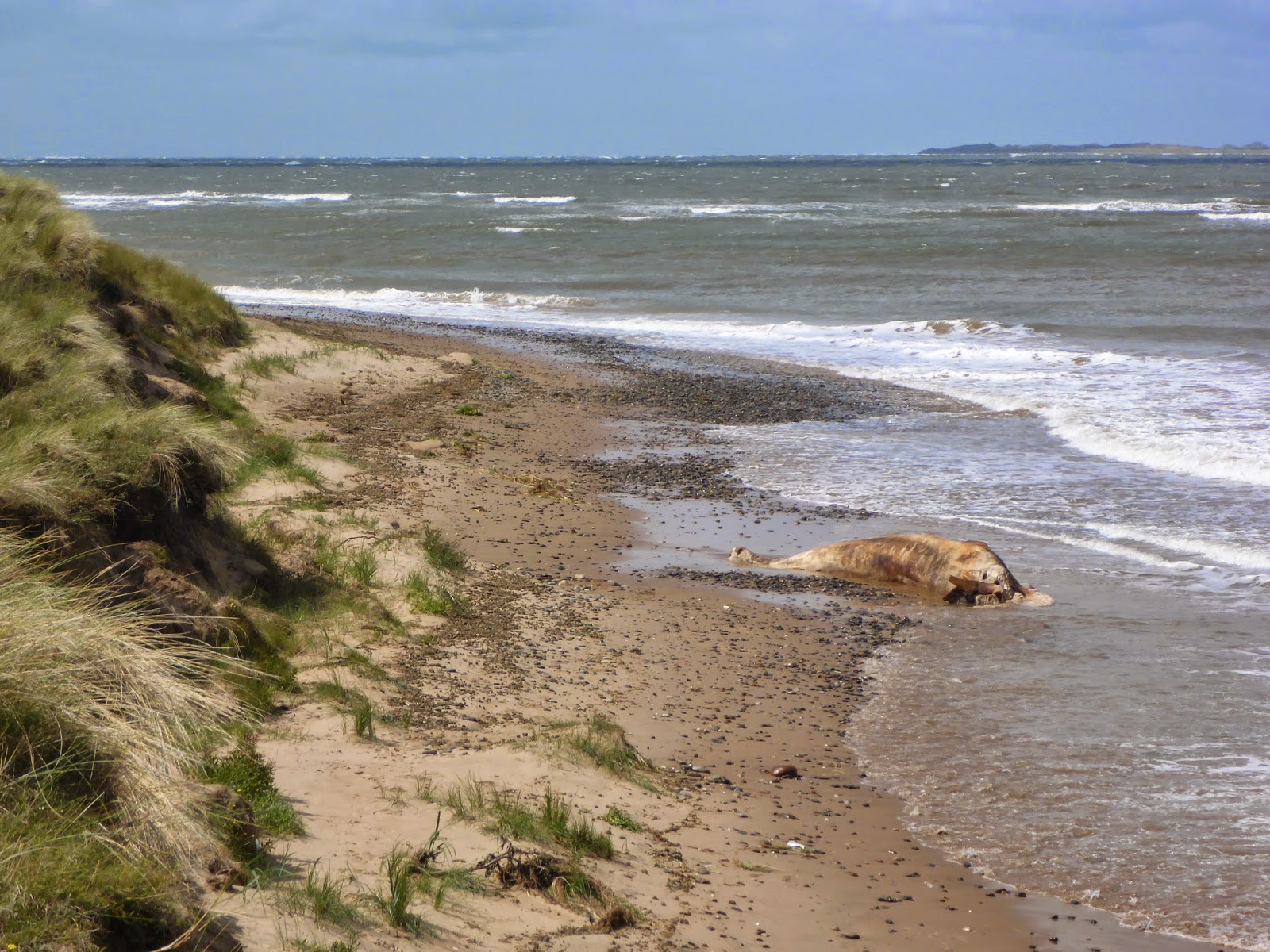
 On the 17th July  2014 a dog walker reported a dead whale that had washed up on the beach.  Having experienced reports of a killer whale the year before, which actually turned out to be a habour porpoise, we weren’t really expecting to find what we did.

In fact an 8.3m whale, which at this point believe to be a minke whale, had kicked the bucket and landed on our beach.
WDCS/Lucy Molleson
Minke whales are the smallest of the baleen whales although still reaching a maximum of 9m. They feed by opening their mouths as they swim engulfing large amounts of water along with their food.  When the mouth is closed the water is pushed out through their baleen plates. As they have a relatively short baleen as well as krill and small fish, they can also catch larger fish such as cod and haddock.
For these reasons they are often seen in British waters where food is readily available to them.  Whilst many dead whales will just sink to the bottom of the sea, the high tides and heavy winds might have caused this one to become washed up.

The water table in the first burial was so high it made burying it a hard task.

So what do you do with a dead whale?
First port of call was the UK Cetacean Stranding Investigation Programme funded by DEFRA.  They collate a range of information such as the date and location, along with the species, gender, length and condition of the animal.  All this data can go on to give the bigger picture of what is happening in the wider environment and gives a general indication of the health of cetacean populations.
 With everything recorded we had to decide what to do with it.  Many different organisations were contacted and through this networking a plan of action was made.  We were going to bury it.

So on the 25th July, just 8 days after it appeared, Stinky (as we have affectionately called it) was first shot and then cut open to release any gases, DNA samples taken and finally the carcass was buried using a large mechanical digger.  A post was placed in the ground marking the spot. 


The high tides have brought Stinky to the surface once again, but this time it's on the move
 Jump forward to Monday 11th August and we experience further high tides and heavy winds and… Stinky is back from the grave!  Every high tide sees Stinky move a little further down the beach towards the main family area and all we can do for now is watch.  As the tides begin to retreat we then fence the area off again and set a plan to rebury.


Second times a charm (hopefully!)
 Fortunately this time around the whale has come further towards the dunes where the water table is higher and the grave can be dug deeper as the sides are less likely to cave in.  So for the second time, we have a moments silence and hope that Stinky our Minke is finally laid to rest.
Bob watches as the chances of a smelly roll about, slip through his paws
The many dogs that visit our beach can now run free with owners knowing they are not heading straight for the whiff of death and the joy of a smelly roll!  Sorry pups!